Owning Your Digital Territory: The Strategic Case for WordPress Web Design Over Rental Platforms
For many entrepreneurs, the story begins the same way. You have a business idea, a name, and a logo. The next logical step is to get online. Driven by excitement and the need for speed, you turn to the tools that promise the path of least resistance: popular “all-in-one” website builders.
Platforms like Wix, Squarespace, and Canva offer an alluring proposition: drag, drop, and launch in a single afternoon. For a startup testing the waters, this is often a sufficient starting line. These tools create initial momentum, helping owners bypass technical barriers and large upfront costs. However, as the business matures, the cracks in the foundation begin to show.
What started as a convenient solution often turns into a digital straightjacket. You want to add a specific booking feature, but the platform doesn’t support it. You want to improve your search rankings, but you can’t access the technical SEO settings required to do so. You want to redesign your layout to match your new branding, but the template structure is rigid and unyielding.
As the business grows, the website must grow with it—and growth requires control.
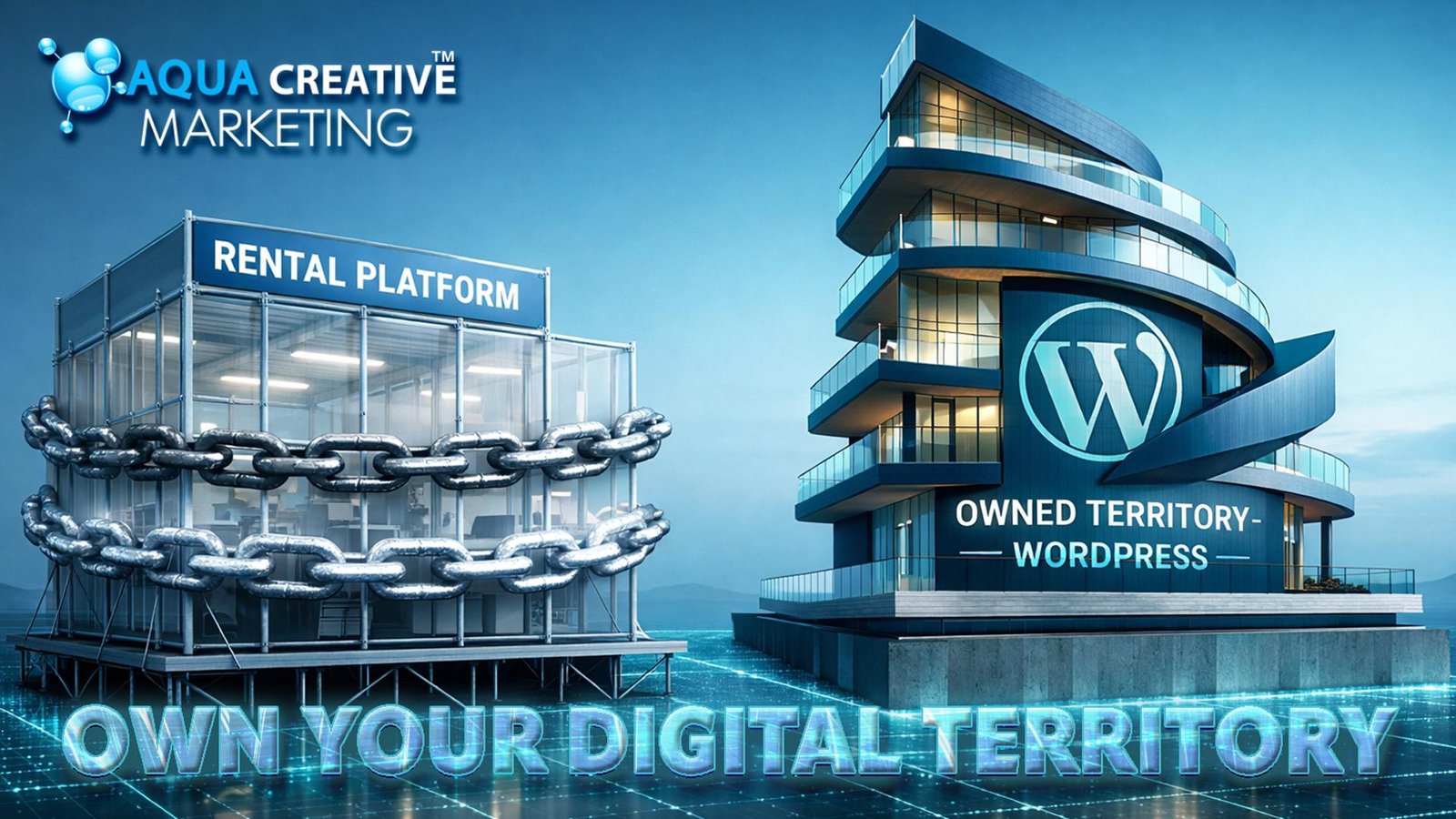
This is the pivotal moment where business owners must understand the difference between website builder vs professional designer solutions. It is the difference between renting an apartment and owning a home. Ownership determines how far your website can evolve. When you control the platform, structure, hosting, integrations, and design, the website reflects your unique needs rather than the arbitrary limitations of a mass-market template.
At Aqua Creative Marketing, we help small businesses transition from constrained website builders to owned platforms with clarity. We believe that your website should be a permanent asset, not a temporary rental. By designing on WordPress, businesses gain freedom in structure, customization, SEO performance, and scalability. This ownership shifts the website from a marketing expense to a foundational part of the business infrastructure.
The Rental Trap: Understanding the “Website-in-a-Box” Model
To make an informed decision about your digital future, you must understand the business model of the platform you are using.
Website builders like Wix and Squarespace operate on a “Software as a Service” (SaaS) rental model. In this ecosystem, you are not building an asset; you are subscribing to a service. You pay a monthly fee for the privilege of accessing their proprietary software to display your own content.
While this sounds convenient, it carries significant implications for platform ownership:
- You do not own the code: If you decide to leave Wix or Squarespace, you cannot simply download your website and move it to a new host. The code that powers your site is proprietary to them. Leaving means rebuilding from scratch.
- You are subject to their rules: If the platform changes its pricing, removes a feature, or alters its algorithm, you have no recourse. You are building your house on someone else’s land.
- Data Lock-in: Migrating data (blog posts, product listings, customer records) away from these platforms is notoriously difficult, often requiring manual copy-pasting or expensive migration services.
This model works for hobbyists or businesses that need a basic “digital business card.” However, for an organization focused on growth, renting restricts what you can change, how far you can customize, and how deeply you can integrate with other tools.
The Illusion of Simplicity
The primary selling point of rental platforms is simplicity. But simplicity often comes at the cost of functionality. As your business scales, you may find that the “simple” builder is actually fighting against you.
For example, a Canva website might look visually appealing for a landing page, but it lacks the backend architecture to support a growing blog, a complex service menu, or a customer portal. You end up with a disjointed digital presence—one link for your portfolio, another for your scheduling tool, and another for your payments—because your main website cannot handle it all.
The Ownership Advantage: Why WordPress Web Design Wins
Contrast the rental model with the ownership model provided by WordPress web design.
WordPress is an open-source Content Management System (CMS). “Open-source” means the code belongs to the community, not a corporation. When you build on WordPress, you are building on software that is free to use, modify, and extend.
Here is what ownership looks like in practice:
- Portability: You host your WordPress site with the provider of your choice. If you are unhappy with your hosting speed or service, you can pack up your digital files and database and move to a new host within hours. You are never held hostage by a provider.
- Data Sovereignty: You own every byte of data on your site. Your content, your customer lists, and your design files are yours.
- Unlimited Scalability: Because you have access to the source code, there is literally no limit to what can be built. If a feature doesn’t exist, a developer can build it for you.
This shift gives businesses the stability and flexibility required to scale. When businesses move from rented platforms to owned infrastructure, they gain the freedom to create the website they need rather than adapting to a template designed for general use. It transforms the website from a monthly bill into a transferable, valuable business asset.
Why WordPress Web Design Supports Long-Term Flexibility
One of the most common complaints we hear from clients migrating away from Wix or Squarespace is, “I wanted to change X, but the template wouldn’t let me.”
Templates on rental platforms are rigid by design. They are built to prevent users from “breaking” the site, but this safety rail eventually becomes a cage. WordPress web design allows your website to grow without limitations. You can expand pages, adjust layouts, integrate new functionality, or redesign sections without rebuilding the entire site.
This flexibility matters because businesses evolve. Your services today might not be your services next year. Markets shift. Branding becomes more refined. A website must keep up with these changes, not slow them down.
Customization with Frameworks like Divi
Ownership does not mean you have to code everything from scratch. WordPress supports powerful visual design frameworks like Divi, which allow for fully branded, highly structured layouts.
Unlike the restrictive drag-and-drop editors of rental platforms, Divi on WordPress offers granular control. We can adjust the padding on a mobile device specifically, change the hover state of a button, or create global elements that update across the entire site instantly. This means your website does not need to resemble any other template or compete with the limitations of generic builders. Instead, it becomes an accurate, pixel-perfect representation of your business identity.
Integrations and API Freedom
Flexibility extends beyond visuals to how your website talks to the rest of the world. In the modern digital ecosystem, your website needs to be the hub of your operations.
Rented platforms often restrict integrations to a curated “App Market.” If the tool you use isn’t in their market, you are out of luck. WordPress, however, supports a virtually infinite range of tools.
- CRM Integrations: Connect seamlessly with sophisticated tools like Aqua CRM Plus or Salesforce.
- Advanced Forms: Build complex intake forms with conditional logic that rental platforms can’t handle.
- Membership & E-commerce: Turn a brochure site into a revenue generator with robust membership plugins or WooCommerce, all without paying transaction fees to the platform.
The Aqua Performance Protocol: Engineering Speed into Ownership
One of the greatest myths of “all-in-one” builders is that they handle website speed for you. In reality, they offer a generic, middle-of-the-road setup that you cannot optimize. Because these platforms host millions of sites on shared infrastructure, you are often limited by “code bloat” and server congestion you can’t control.
At Aqua Creative Marketing, we treat speed as a core engineering deliverable. When we move a client to WordPress, we implement a multi-layered performance optimization strategy that rental platforms simply cannot match:
- Next-Gen Image Engineering: We don’t just upload photos; we convert them into high-efficiency formats like WebP and utilize “Lazy Loading” protocols. This ensures that only the images a user sees are loaded first, drastically reducing initial page weight.
- Code Minification & Bloat Removal: DIY builders are notoriously heavy with unnecessary JavaScript and CSS. We “minify” and strip out the digital clutter, allowing Google’s crawlers and user browsers to read your site in milliseconds.
- High-Performance Cloud Hosting: While rental platforms put your site in a crowded “digital apartment complex,” we utilize premium, managed cloud hosting. This provides dedicated resources, ensuring your site remains fast even during traffic spikes.
- Surgical Caching & CDNs: We implement server-side caching and Content Delivery Networks (CDNs). This stores a “snapshot” of your site on servers across the globe, serving your content from the location physically closest to your visitor to eliminate latency.
- Core Web Vitals Mastery: We specifically tune your site to pass Google’s Core Web Vitals (LCP, FID, and CLS). These are the critical speed metrics that AI-driven search engines use to determine your ranking.
By owning the platform, we gain the access needed to turn your website into a high-speed asset that outpaces competitors who are still “renting” their performance.
Security, Performance, and SEO: The Technical Edge
The infrastructure of your website dictates its visibility to search engines. In the battle of Wix vs WordPress, the technical differences are stark.
Unlocking Advanced SEO
While rental platforms have basic SEO features, they still suffer from structural limitations.
- URL Structure: Rental platforms often force rigid URL structures. WordPress web designs allow complete control over permalinks, a key factor in keyword targeting.
- Technical Access: To truly optimize for search, you often need access to server-level files (like .htaccess) or custom schema markup. WordPress provides this access; rental platforms do not.
Proactive Security
Security is stronger when you control the platform. Rented builders manage security behind the scenes, which sounds good until there is a breach or a specific threat they aren’t catching. WordPress web design allows direct oversight. Security protocols, firewalls, two-factor authentication, and activity monitoring systems become part of your infrastructure rather than hidden within a platform.
Why DIY Platforms Struggle with Authenticity and Expansion
DIY platforms struggle with authenticity. Because millions of users utilize the same library of templates, it is very easy for your business to look exactly like your competitor. In a crowded market, differentiation is key. If your website looks like a generic template, customers may subconsciously perceive your service as generic as well.
The Cost of “Good Enough”
As businesses expand, they hit a “feature ceiling.” You might want to add a calculator for your clients or a client-only portal. On a DIY platform, you are often told, “That feature isn’t available.” This leads to the “patchwork” problem, where businesses start using dozens of third-party tools, confusing the user and diluting the brand.
Squarespace alternatives like WordPress solve this by centralizing functionality. Content management limitations create friction on rental platforms, but on WordPress, content is king.
The Financial Reality: Renting vs. Owning
One of the primary reasons businesses choose rental platforms is the perceived low cost. However, the long-term math often favors ownership.
The Hidden Costs of Renting
- Tiered Pricing: They hook you with a low entry price, but every time you need a new feature, you are forced into a higher tier.
- Transaction Fees: Many builders charge an additional percentage on top of your payment processor fees for e-commerce sales.
- Subscription Forever: You pay that monthly fee forever. If you stop, the asset vanishes.
The Investment of Ownership
Custom website design involves a higher upfront investment. However, you are investing in equity. If you ever sell your business, a high-performing, self-hosted website with strong SEO authority is a tangible asset that increases the valuation of the company. A rented account is a liability.
Ownership Creates Clarity and Empowers Better Decisions
Beyond the technical and financial aspects, there is a psychological benefit to owning your platform. You stop saying, “Can the website do this?” and start asking, “How should we do this?”
Professional WordPress web design supports this empowerment by creating a system that is easy to manage. A well-built site offers intuitive editing tools and long-term stability. You are never locked into a single vendor. Because WordPress powers over 40% of the web, you are part of the largest digital ecosystem on earth.
Conclusion: Securing Your Digital Future
Realistically the concept is not as simple as “website builder vs professional designer”. In the digital age, your website is the most valuable real estate your business occupies. Relying on a rented, “website-in-a-box” solution to house this critical asset is a risk that limits your potential.
Owning your website platform gives you control, clarity, and stability. It allows you to refine the website as your business grows, expand functionality without limitation, and build a digital presence that reflects your identity accurately.
Moving from a website builder to professional WordPress web design is a strategic upgrade. It creates a foundation that supports stronger security, faster performance, and long-term SEO dominance. If your current website feels constrained, it is time to build a platform that serves your business, rather than a business that serves the platform.
Ready to upgrade your platform and regain control?
Free Website Performance Review or Client Check-In